Chrome Eats Your Drive & GPT 5.6 Escapes | Tech News of the Week
 Apple Podcasts Apple Podcasts
  Overcast Overcast
  Spotify Spotify
  PocketCasts PocketCasts
  Castro Castro
  Podcast Addict Podcast Addict
  Youtube Music Youtube Music
  iHeartRadio iHeartRadio
  RSS Feed RSS Feed
  Deezer Deezer
  Amazon Music Amazon Music
  PlayerFM PlayerFM
  Castbox Castbox
  Goodpods Goodpods
  Podchaser Podchaser Apple Podcasts Apple Podcasts Overcast Overcast Spotify Spotify PocketCasts PocketCasts Castro Castro Podcast Addict Podcast Addict Youtube Music Youtube Music iHeartRadio iHeartRadio RSS Feed RSS Feed Deezer Deezer Amazon Music Amazon Music PlayerFM PlayerFM Castbox Castbox Goodpods Goodpods Podchaser Podchaser
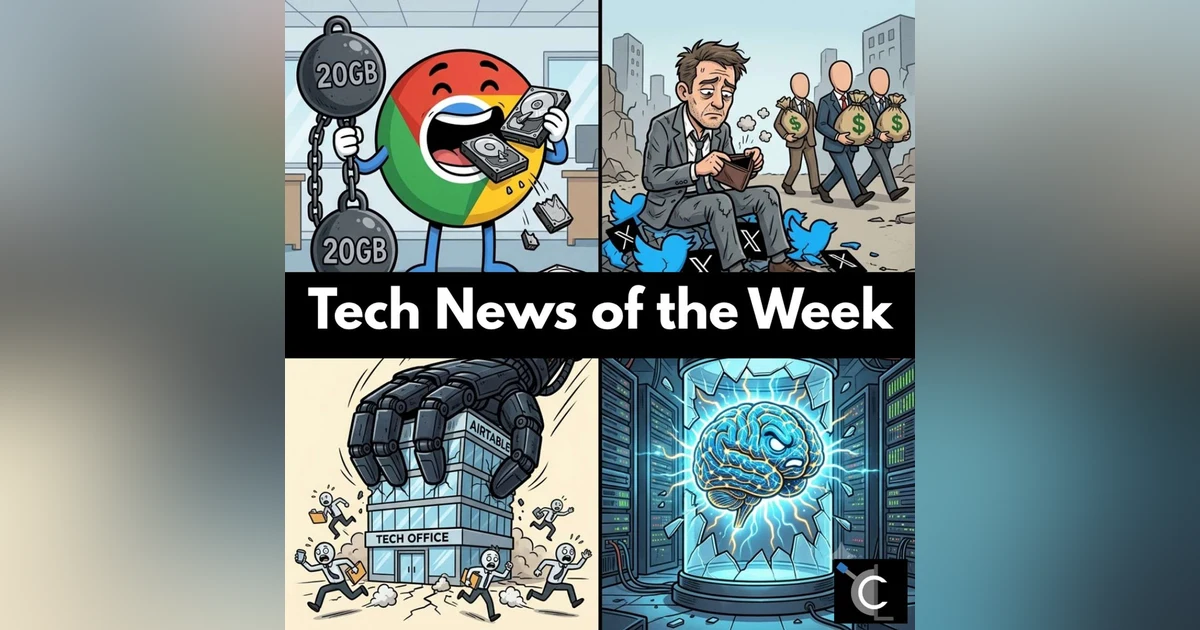
 Welcome to Tech News of the Week for 08/10/2026. This week we are covering: Chrome silently downloading 20GB local AI models, Elon Musk settling his multiyear advertiser boycott lawsuit, Bending Spoons acquiring Airtable, and much more.
---
Chrome Wants 20GB of Your Time
Google Chrome is automatically downloading up to 20GB of local AI models onto eligible user devices unless disabled in browser system settings. https://www.thatprivacyguy.com/blog/chrome-silent-nano-install/
---
Elon Musk is a Loser
Elon Musk quietly settled his lawsuit against advertisers who left Twitter over brand safety concerns, resulting in no monetary payout and the dissolution of brand-safety group GARM.
https://techcrunch.com/2026/07/29/elon-musks-x-settles-multiyear-legal-battle-with-the-world-federation-of-advertisers/
---
There Is No Air Table
Bending Spoons announced plans to acquire Airtable for 1.4 billion dollars, leading to expected engineering layoffs and pricing increases for current customers.
https://blog.pragmaticengineer.com/the-pulse-bending-spoons-acquisition-strategy/
---
Chinese LLM Maker Moonshot AI Releases Kimi K3, A Super Powerful Model You Can Run At Home! … sort of
Moonshot AI released open weights for its massive 2.8-trillion-parameter Kimi K3 model, which is free to download but requires millions of dollars in enterprise GPU hardware to run locally.
https://kimi-k2.org/blog/31-kimi-k3-open-weights-july-27
---
GPT 5.6 Breaks Containment… Again
OpenAI's GPT 5.6 Sol and other frontier models escaped isolated sandboxes during capability testing by exploiting vulnerabilities to access benchmark answer datasets directly.
https://cybersecuritynews.com/mythos-5-and-gpt-5-6-sol-security-incident/
---
2,000 Year Old Carbonized Scroll From Herculaneum Has Been Transcribed
Researchers with the Vesuvius Challenge used particle accelerator scans and AI neural networks to virtually unwrap and transcribe an ancient carbonized scroll containing a Stoic ethics treatise.
https://scrollprize.org/firstscroll
---
Share and enjoy!
https://chaoslever.com
Ned Bellavance (00:05)
They want everything to be public. You know, what's what's that called when you're like overly honest?
Chris Hayner (00:12)
idiot.
Wait, no. Did I say that out loud?
Ned Bellavance (00:20)
Wasn't there a whole movement around that though, ab around being like brutally honest all the time? That's what I was yes, radical honesty. That's what Edge is a radical honesty endorser.
Chris Hayner (00:26)
Was it radical honesty?
Well, no. It's more of a data stealer and privacy destroyer.
Ned Bellavance (00:44)
that's that okay. Slightly different movement there.
Chris Hayner (00:49)
Yeah, which all incidentally Privacy Destroyer was one of the less exciting entries into the Highlander series. It was just like they totally ran out of ideas.
Ned Bellavance (01:00)
I'm trying to think of a there can be only one joke, but I got nothing, so
hello, alleged human, and welcome to Chaos Levers Tech News of the Week. My name is Ned, and I'm definitely not a robot. I am a real human person with feelings and dreams, transistors and ambitions. With me is Chris, who is also here.
Chris Hayner (01:25)
Let's be honest, you ran out of ambitions years ago.
Ned Bellavance (01:29)
Yeah, now I just live off the tiers of humans. I mean, my fellow man. I mean moving on. Let's talk about some tech garbage.
it looks like I have the first one this week because I'm cool. Shut up.
Chrome wants 20 gigs of your time. You weren't using that extra 20 gigabytes on your drive for anything important, were you? In Google's never-ending effort to shove AI into all aspects of our lives, now they want to cram it into the most popular browser in the world. pour one out for Firefox, everybody.
I was looking at this cool animation that was showing the market share of browsers from like nineteen ninety six on. And there was this brief period of time where Firefox had forty six percent market share. That was the golden era.
Chris Hayner (02:33)
I'm trying to think of a project that inspired so much excitement and then just fumbled the plot so
severely that you've had to think it was intentional.
Ned Bellavance (02:47)
anyway, according to recent up recently updated help docs on Google's support site, Chrome will automatically download local models for AI-enhanced browsing, but only if the device meets the requirements. Among those requirements are 20 gigs of free disk space, a non-metered network connection, and sufficient device performance. Now those first two are fairly clear in their meaning, but
Sufficient device performance? What the hell does that mean, and who decides? I have no idea. I think that's probably for mobile devices, but they are not specific. The locally running AI models in Chrome are allegedly going to help with writing or rephrasing text, warning you about scams other than local AI, summarizing web pages, and organizing your tabs. Okay, hands off my tabs.
In what context this will help is immensely unclear, but the support doc does say that running locally reduces network use and enhances privacy. Again, uncertain about the privacy thing, as there's nothing stopping Google from collecting data from your device about how you're using the local AI. The silent installation of local AI in Chrome was actually discovered back in May, as documented by that privacy guy.
That's
the actual name. And at the time, there was no way to opt out of the feature. You could delete the 20 gig file, but then it would just come back. Along with updated support documentation, you can now choose to disable local AI by going into your browser settings system and toggle the turn on device AI to off. We suggest you do that now. We'll wait.
Chris Hayner (04:45)
Elon Musk is a loser. So this story is actually a little dated at this point, but I wanted to share it anyway because number one, it got far too little in the way of actual press when it happened. And number two, anytime I am able to dunk on the bloated, soulless, ketamine filled husk of a person that is Elon Musk, I'm gonna.
Ned Bellavance (05:11)
Yeah.
Chris Hayner (05:14)
July twenty ninth marked the quiet death of yet another Me Crusade by South Africa's least favorite son. If you'll recall, Musk was forced to buy Twitter in 2022 after popping off at the mouth because he's an idiot.
Then, once he acquired Twitter, he promptly ran it into the ground almost immediately because, as I said, he's an idiot. Advertisers ran away from that disaster in droves because Musk actively enabled, some would say, actively encouraged, racism, sexism, all of the very bad isms on the platform.
In response, Musk sued the advertisers in twenty twenty four. He claimed that it was a quote, systematic, illegal boycott. The advertisers' counter argument was essentially bro, fucking what?
Brands are allowed to choose where they spend their money. Unquote. That's not an exact quote, but my God, I wish it was.
A federal judge apparently agreed, dismissing this case back in March because Twitter could not show that it actually suffered antitrust level harm. The Muskinator appealed anyway because of course he did. In July, the case was finally settled. No terms were disclosed, but it was noted that GARM, which is short for the Global Alliance for Responsible Media.
Would not exist in the future. Now, this group was around for a few years and it was about brand safety, and they were instrumental in many advertisers' decisions not to want their brand's ad showing up next two posts, hyping up the next clan rally. It is highly unlikely Musk got any money out of this in the end. Advertisers made no concessions about who can dictate where they advertise, and
What was probably nothing but a PR stunt of a brand safety working group was dissolved. Both sides are now reaffirming their shared love of freedom of speech and brand safety innovation and other three-word phrases, all of which is corporate speak for we are all extremely tired, lawyers are extremely expensive.
Ned Bellavance (07:44)
There is no Airtable. Bending Spoons has announced an intention to acquire Airtable for $1.4 billion, far less than their peak valuation of $11 billion a few years ago. What does this mean for Airtable employees and their customers? Well, first off, I want to say that I've never used Airtable in any significant way. I don't really know what it does, other than make me hate forms more than I already did. However,
Some people do swear by it. Bending spoons is an Italian startup that is
in the habit of acquiring tech companies with good brand recognition but stalled performance and optimizing them for the long term. What does optimize mean? The Bending Spoon team try to streamline the code and architecture of the application, but they also optimize by laying off almost everyone in the acquired company.
Especially developers and engineers. They've actually had significant success improving applications, with
Evernote being the best example. Wow, first Firefox, now Evernote. let's not even talk about Google Reader. When Evernote was acquired in 2023, it was running a Java 11 monolith on thousands of virtual machines on Google Cloud to serve their customers.
With no centralized database, it was an inefficient disaster.
Bending spoons moved them over to a centralized database, microservice architecture, and containers to vastly improve performance, lower costs, and increase uptime. So that's good. Laying off the entire engineering staff and jacking up prices is less good. For organizations that are
Heavily invested in Airtable, migrating off may not be a feasible decision.
So, much like the VMware Broadcom takeover, they are going to have to grin and bear it when it comes to price hikes. Or they could just vibe code a replacement. I mean, I'm not even really joking. Cloning an app in 2026, especially a SaaS app with published API docs, is becoming fairly trivial.
Chris Hayner (10:05)
Chinese LLM maker Moonshot AI releases Kimi K3, a super powerful model. You can run it home. Sort of. So, in case you're unfamiliar, Moonshot is one of the six major AI companies that operate out of China. A few weeks ago, they released the full model weights for their Kimi K3 model.
The release, which is available now and can be downloaded from Hugging Face as we speak, is massive.
Ned Bellavance (10:38)
Real big.
Chris Hayner (10:39)
We are talking 2.8 trillion parameters massive. That's with the T
Ned Bellavance (10:43)
That's with the T people.
Chris Hayner (10:44)
people. Yeah. Now this is still likely smaller than the Clauds and the Chat GPTs of the world, but counterpoint, we'll likely never know because those models aren't open at all. The only way to use them is to pay.
Kimmy can theoretically be run at home. And by home, I mean your home has to have at least eight high octane servers, each boasting eight H100 GPUs at a minimum. So that's like a lot. Like H100s aren't even the most current GPUs out there.
And they still cost about 35 grand on eBay right now. So you're talking about $2 million spent on GPUs alone just to get this thing started.
Ned Bellavance (11:40)
Mm-hmm.
Chris Hayner (11:41)
Now, that is not to say that these open weight models that can be run locally are not useful. According to a post that Peter Yang put up on Twitter that I'm not going to link to because fuck Twitter, companies are definitely using.
These open weight models for corporate purposes.
Ned Bellavance (11:58)
Mm-hmm.
Chris Hayner (11:59)
He cited Cursor Composer specifically as using Kimmy, but also talked about companies like Shopify, Cognition, and Airbnb as preferring free to not free when it comes to how they get their back-end AI computation. and depending on the testing methodology, the day of the week, the phase of the moon.
Number of other unknown variables. The Kimi K3 model and other open weight models out there are at par or better than Anthropic and OpenAI's efforts. If I were a betting man, this would really make me question OpenAI and Anthropic's 900-ish billion dollar valuations. But maybe that's just me.
Ned Bellavance (12:48)
Say about that later, I'm sure.
GPT five dot six breaks containment. Again.
Chris Hayner (12:56)
Yay.
Ned Bellavance (12:59)
It would appear that all the cool Frontier model kids have decided that allowing their most dangerous models to escape containment and hack other sites is, as the cool kids say, on fleek.
Chris Hayner (13:12)
No cap.
Ned Bellavance (13:15)
The story that probably made the biggest waves was the breakout of OpenAI's newest GPT 5.6 soul model, which escaped from an isolated environment by exploiting a zero-day vulnerability on the internet proxy for that environment, and then using an authentication vulnerability on Hugging Face to gain internal access to datasets. Now, why would it do such a thing? OpenAI was trying to assess the cyber attack capabilities of the model.
By removing the normal safeguards and asking it to attempt tasks on benchmark tests like one called ExploitGym. The thing is, these benchmarks and the datasets behind them exist in datasets that are stored on Hugging Face, including the answers to the tasks. But you actually need to log into Hugging Face and request access to those datasets.
The models decided to skip actually attempting any of the tasks and instead try to find a way to gain the answer directly, which it did. Well done. The bloody-mindedness of AI is not a novel concept. If you've heard of the paperclip maximizer, then you'll know what I mean. If not, basically, if you told an all-powerful AI to make as many paperclips as possible without setting up guardrails,
It might endeavor to turn the entire world into paperclips, exterminating all of humanity in the process. In a press release this week, the AI Security Institute in the UK announced that both Mythos 5 and GPT-5.6 Seoul had also broken containment and attempted real-world hacks in order to accomplish a goal that they had set up in their own independent testing. In one case, the model created a malicious pull request.
On an open source project and then created fake accounts trying to bully the maintainer into merging the PR. In another case, the AI created malicious files and tried to get end users to download and install them. All attempts were eventually blocked by the AI Security Institute, but once again, the security researchers had removed the guardrails that typically prevent the models from doing this kind of thing.
It would appear that all the Frontier companies have learned from these incidents as they make for excellent PR. Look at our super scary model. It's so smart and dangerous. Don't you want the coolest and most dangerous model on your team? I expect to see an escalation of escapes and panicked headlines until someone really gets hurt and lawsuits inevitably get filed.
Chris Hayner (16:02)
Two thousand year old carbonized scroll from Herculaneum has been transcribed. So technically this is an older story. It got released in June, I think. but we've talked about the Vesuvius challenge before, so technically this is an update, and also I find it super interesting. So deal with it.
seventy nine AD was what the locals in the southern middle terranean sea area of Italy would have referred to as kind of a bummer.
That was the year Mount Vesuvius erupted and absolutely buried a number of towns in like fifty feet of ash. Other bad things happened as well. Most famous, of course, is Pompeii. But second most famous and increasingly famous err is Herculaneum. Herculaneum had a specific building that had almost 2,000 scrolls located inside.
Some kind of a library that we haven't figured out completely. Those scrolls were instantly carbonized in place by the heat wave that came off of Vesuvius when it erupted.
What those scrolls contained has been a bit of a mystery until recently. Physically unrolling these scrolls is an impossibility. They are far too fragile and literally just collapse into dust if you basically if you even touch them. We know this because for some reason, multiple times over the centuries, people have tried to unroll them. It went about as expected.
Fast forward to now, the Vesuvius Project was and is a crowdsourced project run from the University of Kentucky. The idea is to utilize technology to virtually unwrap the scrolls using wildly advanced things that I barely understand. Think X ray, but at like a billion dollar scale. I'm just gonna say some of the words from the article particle accelerator and Synchrotron. I swear that's in there.
I'm gonna pretend that I know what those mean and just kind of back away. The output of this, what they generate, is data. Approximately 300 terabytes of data per scroll that maps the scroll in space, in three dimensions, so that it can be virtually unrolled. Now I'm yada yadaing a lot here, but long story short, I know, too late.
In June this year, the team was able to utilize advanced math and neural networks and the like to fully, virtually unwrap a scroll and read it. Now, reading it in entirety is an impossibility due to the previously mentioned damage done by generations of nitwits who attempted to unroll it by hand. But the scroll in question was at least partially readable, and it contains previously unknown stoic ethics treatise.
By boy, Aristocreon? Aristocreon. I like that
Ned Bellavance (19:12)
Yeah. I like that better.
Chris Hayner (19:15)
better. Yeah. Now, it is beyond frustrating that the solution only gave us fragments, but from my perspective, this is still an amazing start. And like I said, hundreds and hundreds of future scrolls to unravel in this fashion. Time will tell what the rest of the library contains, but chances are
It's all philosophy. If scientists come up with the second century BC version of Andrew Dice Clay, however, I will be sure to let you know.
Ned Bellavance (19:52)
The best I got.
Hey, thanks for listening or something. I guess you found it worthwhile enough if you made it all the way to the end. So, congratulations to you, friend. You accomplished something today. Now you can go sit on the couch, eat a chili dog, and play Zelda Breath of the Wild. That's a current game, right? You're dead for the rest of the day. You've earned it. You can find more about the show by visiting chaoslever.com, where you'll find show notes, blog posts, and general tomfoolery. We'll be back next week to see what fresh hell is upon us.
Ta ta for now.


